Germany has a large number of small and mid-sized companies and, in proportion, far more hidden champions than the rest of the world. As a rule these firms are not digital natives but digital followers or digital immigrants. They form the backbone of the economy, and they are the subject of this piece.
One thing is clear: digitalisation as a whole leads to disruption. New players appear and former market leaders disappear. A few examples make the point. Amazon started as an online bookshop and became one of the world’s largest IT and cloud providers, with annual revenue roughly three times that of IBM – IBM being 108 years old, Amazon only 25. Another example shows even more clearly where digitalisation leads: Daimler had a market capitalisation of around €56 billion [as at Nov 2019, source: www.finanzen.net] and some 298,000 employees [as at 31 Dec 2018, source: geschaeftsbericht.daimler.com]; Netflix had a market capitalisation of €114 billion [as at Nov 2019, source: www.finanzen.net] and just 7,000 employees [as at 2018, source: de.statista.com].
The difference between automation and digitalisation can be shown through a Pareto distribution of value creation over the time employees are present. Automation clearly belongs to core value creation. It always serves a direct increase in performance – capacity or rationalisation – and can be subjected to a payback calculation relatively easily. Digitalisation and Industry 4.0, by contrast, pursue better decision-making through transparency. In further stages the aim is forecasting capability, extended up to automatic adaptation: agility and a self-learning organisation. As with lean approaches, the point is to improve effectiveness – to decide quickly without searching and to do the right thing straight away, thereby raising the share of attendance time spent on core value creation. That is very close to the lean idea of eliminating waste and increasing flow. A direct payback calculation is almost impossible for digitalisation, just as it is for lean. You have to believe in it.
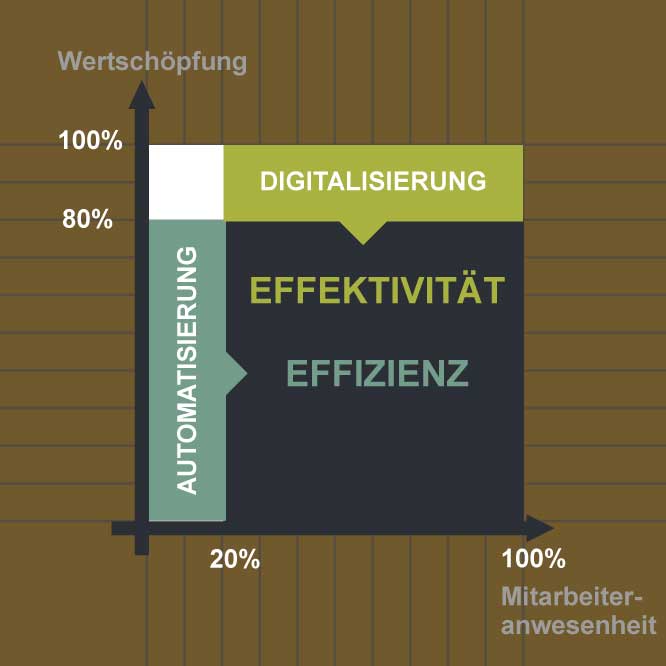
Two routes to greater efficiency Digitalisation is not the same as automation. Digitalisation creates transparency, predictability and effectiveness; automation creates capacity, rationalisation and payback.
Hidden champions around the world
Germany has 15.8 hidden champions per million inhabitants, for example, while Japan has only 1.7.
Digitalisation is not an end in itself
No managing director or owner develops a digitalisation strategy for its own sake. Successful companies first ask where they stand today and where they want to stand in future. They look closely at the markets they operate in and work out how to position themselves. Management then has to weigh up whether and in which areas digitalisation genuinely makes sense – as a user of digitalised business processes, as a provider of new digital offerings, or both.
A manufacturer of goods such as toilet paper, cable or screws will, within its business model, put the emphasis on maximum efficiency: optimising machine running times, minimising changeover losses (smart flexibility) or scrap rates (smart quality).
Operators of large, complex plants – in the chemical industry, say, or a highly automated press shop – will focus on smart maintenance.
In every case it takes transparency, achieved by connecting machines and sensors digitally (smart machines) and holding mass data appropriately (smart analytics). The technical preconditions are considerable. Every machine and sensor has to be connected to the data network, and the resulting flood of data has to be captured in real time (writing) and made available for evaluation (reading). Most corporate networks and servers are not designed for this – let alone the machines being able to communicate their own state. You still find Siemens S3 controllers, DC motors, patchy wireless coverage and much else besides. Incomplete coverage produces blank or blind spots, which then allow only fragmentary conclusions. Technical development is so rapid that a consistent standard is barely reachable before the next, better system arrives. Why invest in wireless when 5G is said to be around the corner?
On the provider side, many fields of action open up behind the buzzwords. At times, though, one gets the impression that companies are experimenting with product features without having found the killer application that would deliver the success they are after.
Data has to flow in both directions
freely across system boundaries.
Continuity of data from design through production to product use brings decisive advantages.
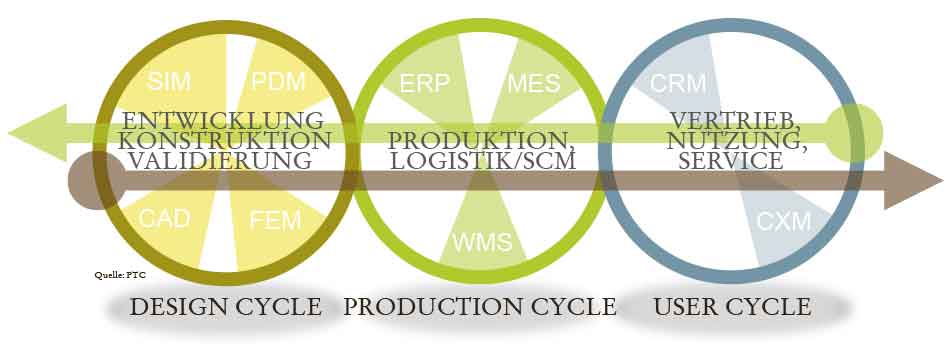
Ultimately the aim must be to improve the user experience, to create lasting customer value and, at the same time, to gain better planning and steering signals from the market for one’s own company – whether for production or for product planning. Continuity of data from design through production to product use is where the decisive advantages lie. The specialised systems of the individual areas have to be opened up for data exchange across the whole cycle.
What matters for digital transformation is the ability to avoid piecemeal over-engineering and dead-end investment. The various IT areas play a key role here – but IT alone cannot act. Data structures have to be built coherently before digitalisation can be applied to any purpose. Those structures are usually defined by experts in specialist departments outside IT, and they have enormous inertia, because new data structures can trigger a huge adaptation effort in the existing estate. The right product architecture is the precondition for capturing and processing data meaningfully at all. That includes the product portfolio, the configuration mechanisms and the representation of products in different views – usually bills of materials and routings.
Existing IT departments are mostly geared to running business IT and adapting it through release changes. Production IT is often run by maintenance, product IT by specialised developers. The emphasis there is on stability and cost efficiency rather than on maximising customer value quickly or optimising the user experience. Marketing frequently uses external agencies that can build attractive, decoupled web solutions fast but always struggle to integrate them with the other areas. The cultural differences between these IT worlds are hard to overcome.
Lasting digitalisation needs a whole ecosystem of different competences
Digital transformation therefore needs many competences if it is to succeed lastingly. Software expertise plays only one leading role in a whole ensemble of different disciplines. Finding a single partner with all of them, in-house or outside, will be difficult. What matters is building a network of competences and developing the company together with those partners. Many of these services cannot be pressed into a licensable product or a rental contract, which means consulting costs that have to be budgeted for.
Unlike automation projects, success here is not easy to plan or measure. Then again, how often have pointless automation solutions been dismantled afterwards because they simply no longer fitted changed markets and products?
In the end, as with lean management, it is not the local introduction of individual methods or components with a short half-life that delivers the benefits, but consistent implementation in the company’s processes and lasting anchoring in its culture.
That already sounds expensive, and it is entirely understandable to shy away from the start-up cost and stay with familiar business models and behaviours. Lean has not become a must for every company either. There are still companies that function without any recognisable lean implementation – but there are fewer of them.
We would therefore argue for finding the strategically right approach with care, and then beginning organisational development in small steps. Benefits can then be generated continuously alongside the insight gained.
pareto managementpartner GmbH & Co. KG forms a competence team for the Mittelstand together with NET.AG. If you are looking for a way into digitalisation, or want to give new purpose to attempts that have not worked so far, talk to us.