
“Where exactly are 4,000 orders supposed to be lying around here?” Poor on-time performance and very long lead and delivery times at a capital goods manufacturer were the reason to analyse lead times in administrative order processing. The result: eight working days on average, with the on-time performance of the administrative steps impossible to determine. Eight days does not sound so bad. But the spread ran from a few hours to many weeks – and that was not necessarily down to the difficulty of the orders or the work they actually required.
At around 500 orders a day and eight days of lead time, 4,000 orders are in circulation. But nobody had really seen them. Invisible inventory and queues were the problem – even though every order moved through the organisation as a physical folder as well as a record in SAP. 4,000 × roughly 2 cm = 8,000 cm. So where was this 80-metre stack lying around?

.… in four dimensions
Lean production is an ideal worth striving for in many companies, because the principle has proved its effectiveness. The central question is whether the approach can be transferred to administration. We are convinced it can.
The familiar dimensions of lean optimisation are muda (waste), mura (unevenness) and muri (overburden). pareto adds a fourth: munou (poor planning). There are many methods for improving these four dimensions; the best known are probably the 5S.
Misreading and overzealousness
In our view there are some striking examples of lean administration misunderstood. For instance:
These examples show the excess. The misunderstanding, in our view, is that what matters is less the organisation of the individual workplace than the input, output and storage of commonly used information – because that information is the product of administration.
The small things in 5S
In 5S terms, the challenge is to sort this information out (seiri), set it in order (seiton), clean it (seiso), standardise it (seiketsu) and sustain and improve all of it (shitsuke). Removing unnecessary ballast, standardising routines and creating room for fast, flexible responses to processes or customer requirements that cannot be standardised – that is the real goal.
The approach for lean administration
The small things in 5S bring real efficiency gains in the office, just as they do in production. In lean production, however, the decisive improvements usually come from approaches that reach further. For that, the aim and the requirements have to be derived from the company’s success factors across the whole organisation. We have gathered decades of experience with lean, in Japan among other places, and from that we have developed a consistent plan. It comprises:
Finding the strategy
To define strategy we use a company model that captures the relationships between markets, products, processes, organisation and foundations. The model allows the decisive requirements for possible changes in the company to be derived, translating expectations of success into objectives and into initiatives and projects.
Analysing and designing the information stream
Lean production uses value stream analysis and design to capture the weak points in existing production flows and to visualise decisive process changes. We have developed value stream design further into information stream design, which allows administrative processes to be included. Administrative processes ultimately serve value creation, and that takes place in the field of tension between generating revenue – the top line, sales – and delivering performance – the bottom line, production. Information stream analysis and design literally span this field and coordinate all activities in time, so that not only the important information flows but also the available time windows become transparent.
Thinking across phases in the design dimensions
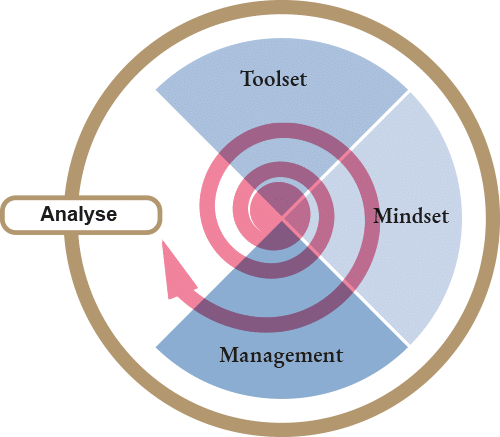
Organisational change usually runs in cycles, which is why we show it as a spiral. It covers the three design dimensions and the analysis phase, which have to be seen together. The organisation passes through the cycle of change repeatedly, extending its own capabilities each time.
1. The management recognises a need for change.
2. It initiates a processanalysis and target process design.
3. The processes are redesigned and the toolset supporting them is extended.
4. The staff change their mindset and extend their skills, so that they can formulate new requirements for the organisation and for management.
And so back to step 1.
If you asked us to summarise the methods and key insights in a single view, we would reach for the nutshell table. Its individual points have proved sound again and again in client projects – not exhaustive, but a good 80 per cent hit. Pareto, in other words.